
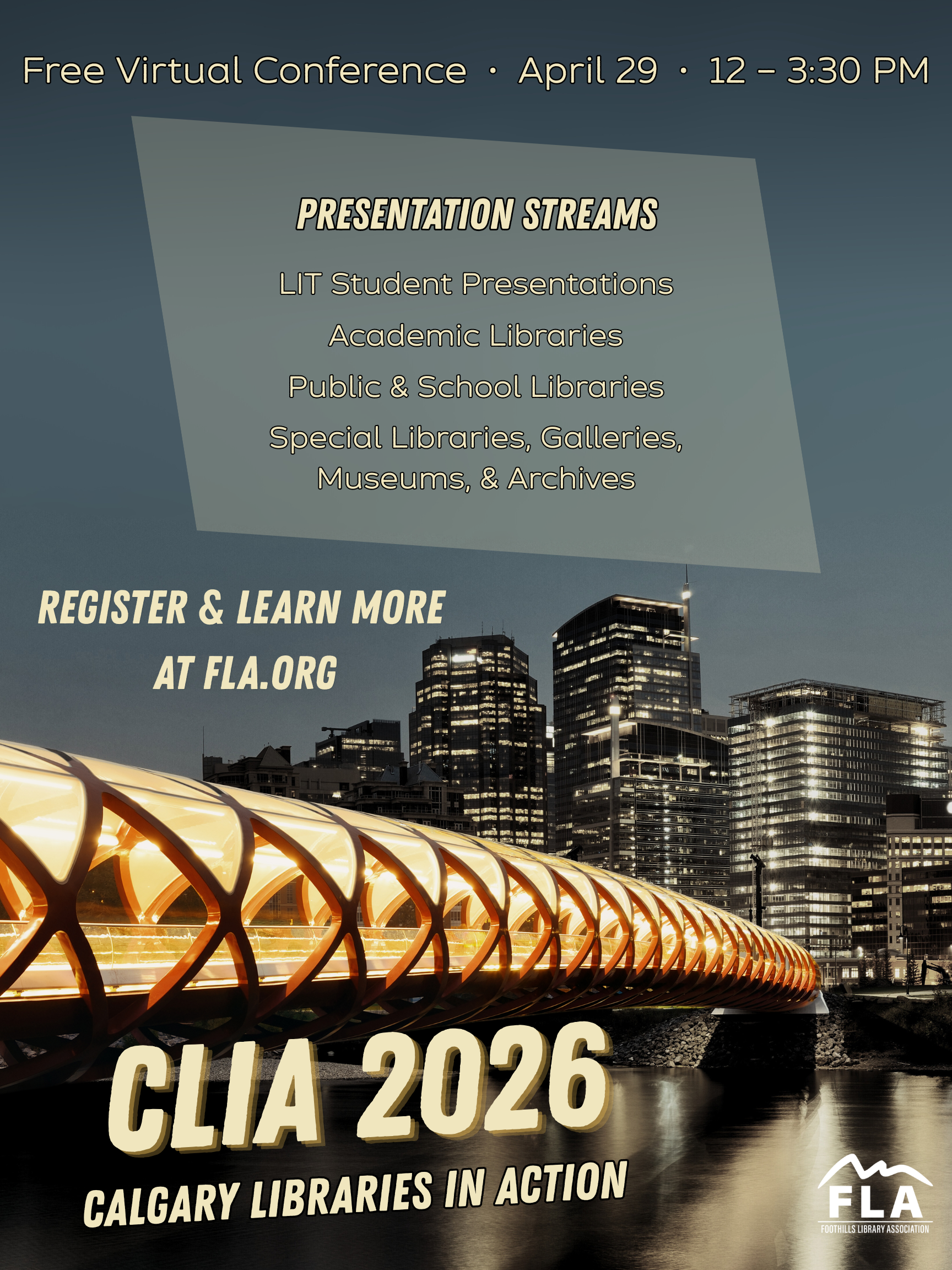
Calgary Libraries In Action was held on April 29th. We thank everyone who presented, participated, and contributed to the conversation.
Many of our presenters consented to have their sessions recorded and made public, and those are now available down below!
Recorded Sessions
Prediction Markets as a New and Distinct Challenge for Information Literacy Theory, by Joel Blechinger
CLICK FOR DESCRIPTION
Prediction markets like Kalshi and Polymarket have exploded in popularity over the last several years (Forster, 2026), and Wealthsimple recently cleared hurdles to launch them legally in Canada (Arsenych, 2026; Brown & Boothroyd, 2026).
In December 2025, Tarek Mansour, co-founder and CEO of Kalshi, made statements at Citadel Securities’ Future of Global Markets Conference that went viral online, claiming, “[t]he long-term vision is to financialize everything and create a tradable asset out of any difference in opinion” (as cited in Gach, 2025). Mansour continued, elaborating his vision that prediction markets can act as an “antidote” for people “living in a world where we have an abundance of information but there’s a lot of noise and we don’t really understand what’s real from what’s not” (as cited in Gach, 2025). This interpretation of prediction markets aligns with the cryptocurrency Ethereum’s co-founder Vitalik Buterin’s earlier assertion that such markets are “social epistemic tools” (Dioquino, 2024). As confirmation of the ostensible value of prediction markets as such “tools,” news provider CNN recently partnered with Kalshi “bringing Kalshi’s data to its journalism across its television, digital and social channels” (Fischer, 2025).
Despite the rapid ascent of prediction markets in news and online popular culture and their clear relevance to information politics, librarianship has been silent on them to date. Using Braman’s idea of information as a “basin of possibility” as a jumping off point (Braman, 2006, p. 17), this presentation will share my preliminary work attempting to think through some of the theoretical issues that prediction markets create for information literacy. For example, how might prediction markets be altering peoples’ orientation towards events happening in the real world, changing that orientation from interpreting events as informing a citizenry to consuming events as speculative outcomes? Furthermore, do prediction markets, as Mansour claims, “surface truth” (as cited in Gach, 2025), or are they a new frontier of misinformation and disinformation being hypercharged by their proliferation on social media networks like X? Other questions will likely arise as I begin work on the presentation.
Works cited
Arsenych, A. (2026, March 29). Wealthsimple is a step closer to offering prediction markets, experts say it is a ‘slippery slope.’ CTV News. https://www.ctvnews.ca/toronto/article/wealthsimple-is-a-step-closer-to-offering-prediction-markets-to-its-investors-but-experts-say-it-is-a-slippery-slope/
Braman, S. (2006). Change of state: Information, policy, and power. MIT Press. https://doi.org/10.7551/mitpress/1783.001.0001
Brown, J. & Boothroyd, G. (Hosts). (2026, March 30). Reality is a casino as prediction markets enter Canada (No. 1338) [Audio podcast episode]. In Canadaland. Canadaland. https://www.canadaland.com/podcast/1338-reality-is-a-casino-as-prediction-markets-enter-canada/
Dioquino, V. (2024, August 26). Polymarket is a ‘social epistemic tool’ for the public, Vitalik Buterin argues as CFTC scrutiny intensifies. Crypto Briefing. https://cryptobriefing.com/vitalik-buterin-polymarket-cftc-defense/
Fischer, S. (2025, December 2). Exclusive: CNN strikes prediction data partnership with Kalshi. Axios. https://www.axios.com/2025/12/02/cnn-kalshi-prediction-market-data
Forster, S. (2026, January 28). Explainer: What are prediction markets? Canadian Affairs. https://www.canadianaffairs.news/2026/01/28/explainer-what-are-prediction-markets/
Gach, E. (2025, December 3). Finance bro thinks it would be cool to turn your entire life into the stock market. Kotaku. https://kotaku.com/finance-bro-thinks-it-would-be-cool-to-turn-your-entire-life-into-the-stock-market-2000650201
Care and Context: Rethinking a Curriculum Resource Collection, by Annie Kavanagh
CLICK FOR DESCRIPTION
Curriculum resource collections (CRCs) have long supported the professional preparation of teacher candidates in education programs at universities and colleges. While professional guidelines on these collections exist, such as those developed by the Association of College & Research Libraries (ACRL), they were last updated in 2017 and are often difficult to apply in practice. As academic programs evolve and libraries face ongoing space and budget pressures, the role and sustainability of CRCs is increasingly uncertain, reflected in the consolidation or closure of similar collections across Canada.
This presentation shares a case study of a large-scale CRC maintenance project within an academic library, undertaken to better align the collection with current program needs, while responding to space constraints in an aging library. Rather than focusing solely on process, this talk highlights the decision-making involved in developing criteria for retention, transfer, and withdrawal, with particular attention to maintaining the context and usability of material.
It also examines the balance between quantitative measures, such as usage data, and qualitative considerations, including feedback from faculty and students, pedagogical value, representation, and the integrity of materials as teaching tools. The presentation also addresses the practical and often invisible labour involved in collection transitions.
Attendees will gain insight into the challenges and opportunities of reworking a teaching-focused collection, along with strategies for approaching similar projects in their own contexts. This case study contributes to ongoing conversations about sustainability, care, and responsibility in collection management.
Evidence Synthesis: A Self-Directed Skills-Building Course, by Heather Ganshorn; Diane Lorenzetti; K. Alix Hayden; Zahra Premji
CLICK FOR DESCRIPTION
Background: Academic libraries are experiencing increasing demand for support around evidence synthesis projects (systematic, scoping and similar reviews). Often, this demand comes from students or from researchers who do not have relevant training in this methodology. Once almost exclusively conducted in the health sciences, evidence synthesis is also being taken up in other disciplines where subject librarians may lack experience supporting these projects. As a result of these pressures, academic libraries are increasingly challenged to scale their support services to meet the demand. While online training programs exist for researchers interested in building their skills, they often provide only superficial coverage of question formulation and search, areas that take up a considerable amount of librarians’ time.
Objective: To develop an online self-directed skills-building course to help meet this demand among researchers, and also among librarian colleagues wishing to build skills to support evidence synthesis. This course is now live at https://libguides.ucalgary.ca/evidence-synthesis-course, and is available to anyone who wishes to take it. Those undertaking a review may complete the course in its entirety, or opt to take only the modules they need.
Key Takeaways: The online course is open to the public, and may be useful to librarians for their own skill development, or to support their users’ learning. This session will be most useful to academic or health sciences librarians.
Can You Escape? Unlocking Ways to Introduce Open Access Through Game-Based Learning, by Adam Cohen & Taylor McPeak
CLICK FOR DESCRIPTION
Game-based learning is a teaching method that uses the power of games to enhance and support learning outcomes. Its purpose is to promote engagement and increase motivation by allowing students to learn through active participation and problem solving. To facilitate game-based learning in a library environment, the Mount Royal University Library adapted and ran the Open Access Escape Room as a part of Open Access Week 2023. This activity provided participants with a primer on open access publishing in the form of an endearing game that saw them attempt to thwart the plans of the evil “Mr. Paywall.” Since its launch, the Open Access Escape Room has run in classrooms, conferences, and professional development opportunities. In this presentation we will be discussing the importance of game-based learning, and the process of preparing for and running the escape room in hopes of inspiring you to include game-based learning in your own library programming.
Photo Merging: Digitizing the “Andre the Giant” of photographs, by Rob Alexander
CLICK FOR DESCRIPTION
In late 2025, Digital Services in the Taylor Family Digital Library at UCalgary set out to digitize an eight-foot-long panoramic photograph of Calgary stretching from the Stampede grounds to Inglewood and beyond. Taken some time between 1911 and 1914, the detail in this panorama is remarkable.
But how do you digitize a photograph that is eight inches “taller” than the famous wrestler Andre the Giant, retain its inherent detail, and protect the original? Use a technique known as photo merging.
Also known as stitching, photo merging is useful when you want to ensure the fine details remain visible and at the same time create a high-resolution digital image, making it especially useful for digitizing large-format negatives, maps, plans, posters, illustrations, and prints.
We took 74 photographs of the panorama and combined them into a single high-resolution image that allows for high magnification of those fine details.
The Calgary panorama is an extreme example, but it makes for a great introduction to photo merging. No matter the size or material type, the steps are all the same.
In this presentation, we’ll explore how photo merging works and how it can be used to digitize both large and small items alike. We’ll also look at what you need to begin using photo merging for your own collections.
1984 or 2026? Alberta’s School Book Ban and the Erosion of Professional Judgment in Libraries, by Alicia Adlington
CLICK FOR DESCRIPTION
In 2025, the Alberta government issued Ministerial Order 034/2025, which established standards for the selection and availability of materials in Alberta schools, particularly their libraries. As of early 2026, at least 160 titles were identified for removal from Alberta schools. Among the removed titles are a disproportionate number of LGBTQ+ affirming materials and, perhaps most ironically, dystopian literature about censorship and control.
Alberta’s book ban is an affront to the professional infrastructure that libraries have built to protect intellectual freedom and serve vulnerable student populations. It displaces librarian judgment and threatens discipline to those who do not comply. Despite being a clear threat to democratic values and library governance, MO 034/2025 is not, for the time being, unconstitutional.
This presentation explores why governments have the legal authority to regulate school library collections, what the Canadian Charter of Rights and Freedoms does and does not protect in this context, and what the displacement of professional judgment means for libraries and the students they serve. Understanding why government actions such as MO 034/2025 are legally permissible is the first step toward understanding why and how libraries and library professionals can resist.
Questions?
Contact us for more information.

